Canadians still love audio. This is true despite the apparent consumer preference for video, and growing public concern about supposed addictions to short-form video and an associated shortening of attention spans.
In fact, 90% of Canadians aged 12+ listened to some form of audio yesterday, including AM/FM radio, streaming music, music on YouTube, audio or video podcasts, SiriusXM, audiobooks, Stingray music channels on TV, and physical media.
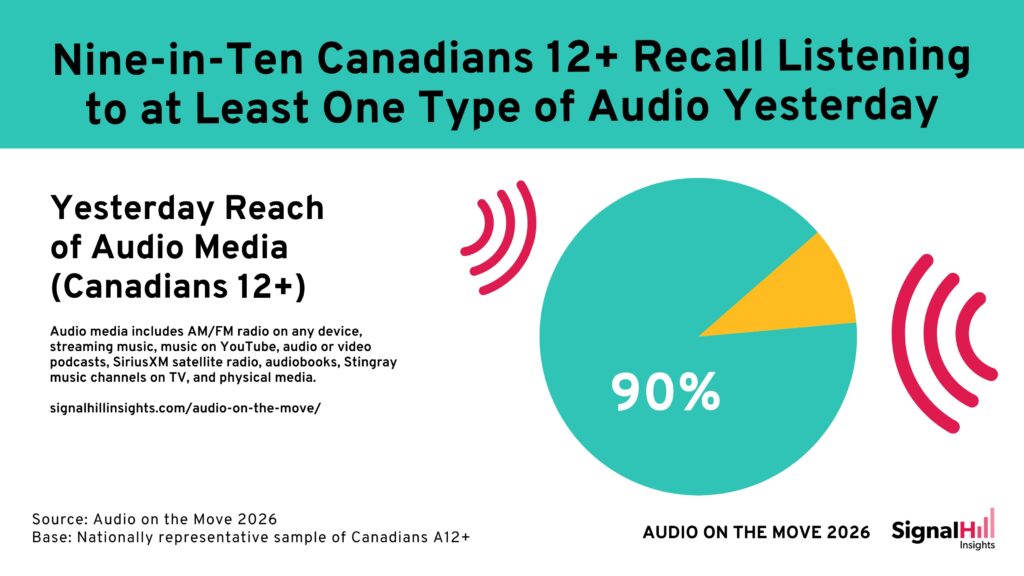
This finding comes from Signal Hill Insights’ new Audio on the Move report, Canada’s first comprehensive and holistic share-of-audio study. It’s based on a nationally representative sample of 6,161 Canadians aged 12 and older surveyed in May and June 2026, asking them to report on their use of audio media yesterday. By recruiting a proportionate sample throughout weekdays and weekends, the sum total of the ‘yesterdays’ represents the average daily consumption of audio.
Half of Canadians’ Listening is Ad-Supported
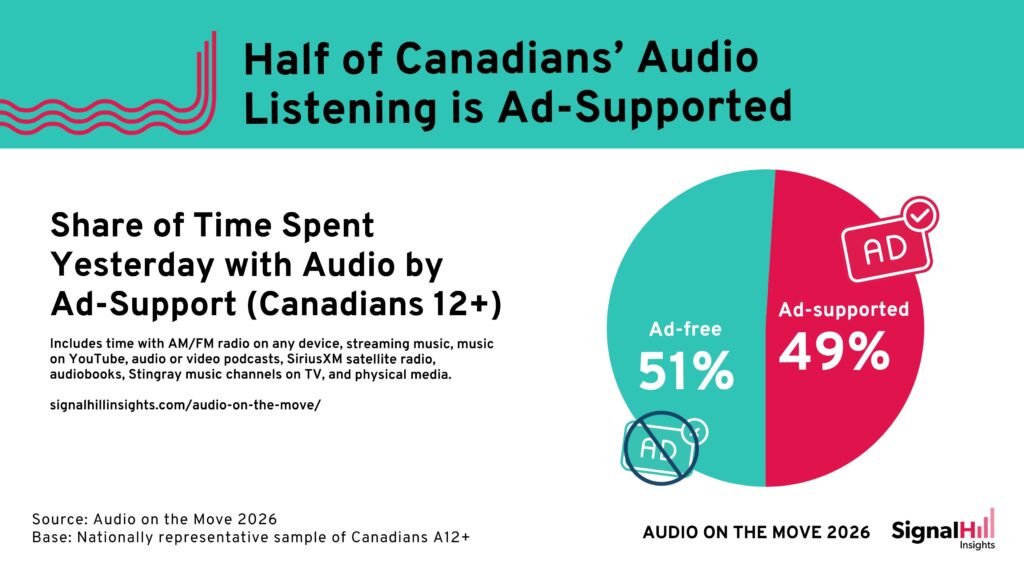
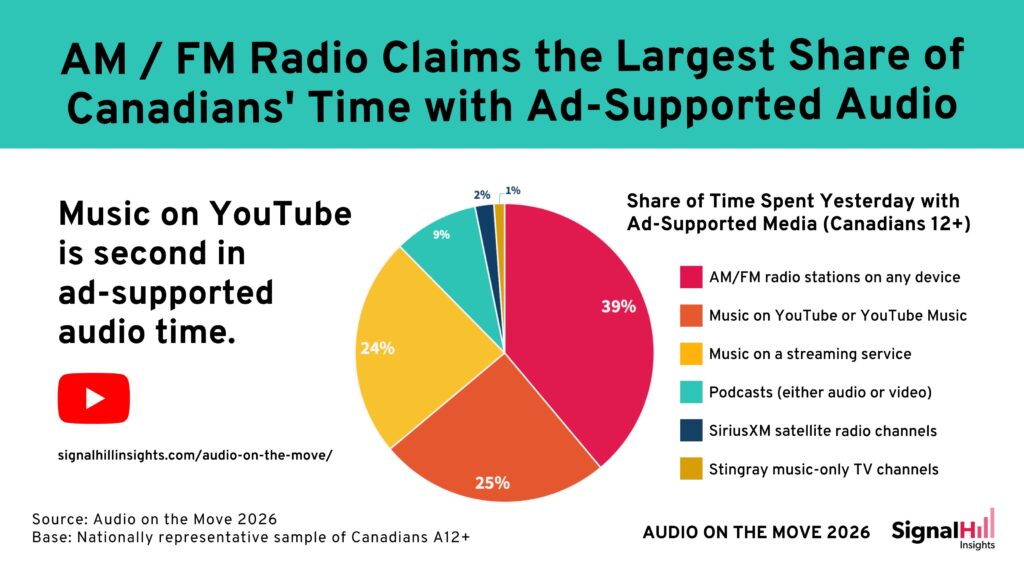
Essentially half – 49% – of daily listening time is supported by advertising. Breaking this down by platform, we find that AM / FM radio on any device continues to lead, claiming 39% of Canadians’ time with ad-supported audio. But the platform in second place might be surprising.
YouTube Is a Growing Ad-Supported Audio Platform
The opening reference to video isn’t incidental. The world’s largest digital video platform, YouTube, is becoming a top destination for audio consumption. The trend towards audiences getting their podcasts on YouTube is now widely acknowledged – in the Canadian Podcast Listener 2025 we found that 40% of last-month podcast consumers said they use the platform most often for their podcasts – more than any other.
That’s why we included YouTube and YouTube Music in Audio on the Move, not just as an overall audio platform option, but also in the ad-supported breakdown. We combined the services into a single bucket because our research shows that consumers do not easily distinguish between them.
Even though YouTube and YouTube Music have ad-free premium options, at most a fifth of users pay for a subscription. So, there’s no doubt that they are fundamentally ad-supported, and that a majority of those listening to music on YouTube are getting ads as part of their experience.
At the same time, we have to acknowledge that this is a complicated picture. YouTube video inventory is usually bought differently than radio or streaming, even while YouTube Music does offer audio ads. But this complexity doesn’t mean it’s wise to ignore the fact that the audio landscape is dynamic and changing.
Consumers aren’t obligated to obey industry silos. A consumer can only listen to one platform at a time, and they’re voting with their ears.
As you might have guessed by now, music on YouTube and YouTube Music squeaks into second place behind radio, accounting for a quarter of Canadians’ ad-supported listening yesterday. Streaming music platforms account for 24%.
Canadians Listen to Music on YouTube Differently
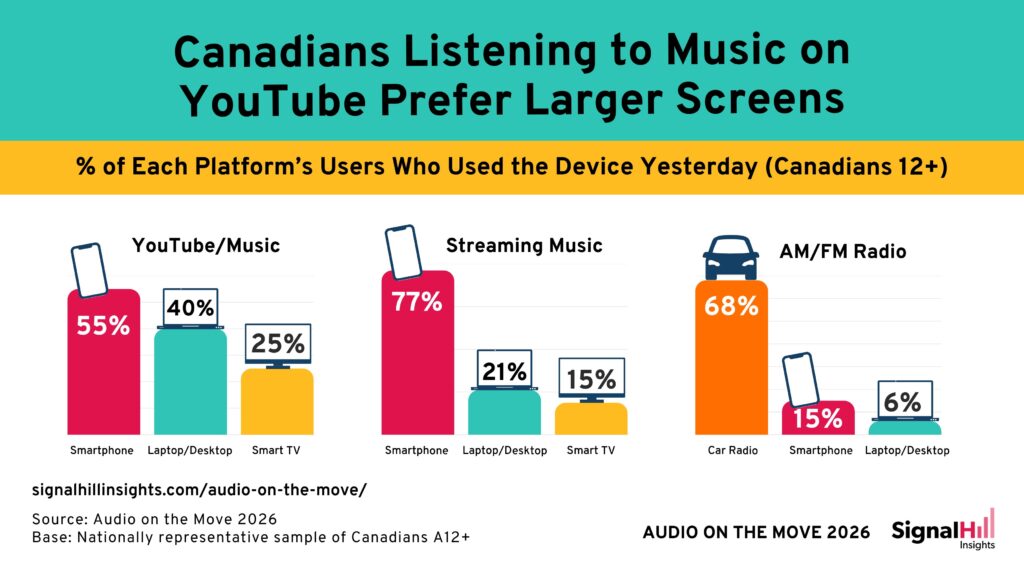
YouTube music listening behaviour has its own distinct signature, especially compared to radio, and even other music streaming. While smartphones are the most used device, only a little more than half (55%) of listeners said they used one for YouTube yesterday. By comparison, more than three-quarters of streaming music consumers (77%) listened on a smartphone. Only 15% of AM / FM listeners used a smartphone to tune in.
A sizeable minority of Canadian listeners show a preference for larger screens for their music on YouTube. 40% used a laptop or desktop computer for music on YouTube yesterday, while 25% used a smart TV. Only 21% of streaming music listeners used a laptop or desktop, and smart speakers are nearly as used, with a fifth of listeners. 15% listened to streamed music on a smart TV.
YouTube music listening is also different through the day: weekday use peaks in prime time, with 20% of these consumers listening at 8 PM. Streaming music use peaks five hours earlier at 3 PM on weekdays, when 25% of streaming consumers are listening. As one might expect, radio peaks in the weekday morning drive, with 26% tuning in at 7 AM.
These are just a few notable findings from Audio on the Move. The full syndicated research report is available by subscription. It contains a full share-of-audio breakdown of Canadians’ daily listening, the percentage of listeners using each platform, the split of ad-supported listening for each platform, share of over-the-air AM / FM radio vs. streaming, and more. Get in touch to learn more.