“If it works with your eyes closed, it’s a podcast.”
I really like this “short version” of the recently released AMP Accords definition of a podcast. The long version is more technical, but no less useful. I like this short version both because it’s simple, and because it pithily captures what is most pertinent about podcasts, whether listened on headphones or pulled up on a smart TV.
But is this something that the average podcast listener, or even the average person, understand?
As the industry mulls and discusses what the AMP Accords offer, I thought it would be instructive to see what the general public thinks a podcast is.
Luckily, we’ve been asking the question since 2023: “How would you describe what a podcast is to someone who has never heard of podcasts?” That comes from Sounds Profitable’s annual Podcast Landscape study, for which Signal Hill Insights serves as research partner. So, we analyzed definitions supplied by 4,819 Americans aged 18+ in the 2025 edition. The study has a total nationally representative sample of 5,034, but only respondents who told us they were familiar with the term, “podcast,” were asked the question.
To better highlight the knowledge gaps and challenges, we divided responses into two groups: people who’ve ever watched or listened to a podcast, and those who never have. For the sake of brevity, we’ll call those groups the “ever-listened” and the “never-listened.”
The never-listened group that could provide a definition is a bit more than a quarter the size of the ever-listened, a clear sign of how mainstream podcasting has become. But their answers deserve close attention, because they point to some of the barriers for the medium’s continued growth.
Overall, nearly all qualifying respondents were able to provide some description of a podcast, regardless of their experience with them. Fever than half a percent of the ever-listened group said they didn’t know or were unsure, while 9x more of the never-listened group gave that response, or 4%. Still, that’s a small number, showing that the vast majority of people have some confidence coming up with a definition.
People Tell Us: Are Podcasts Audio, Video, or Both?
Let’s turn to the essential heart of the AMP Accords definition, the primacy of audio and listening overall everything else. How central is this quality to the public’s perception?
No doubt, video podcasts have become very prominent, causing some to worry that video threatens to overshadow audio. Respondents’ answers indicate that this isn’t a huge threat, yet.
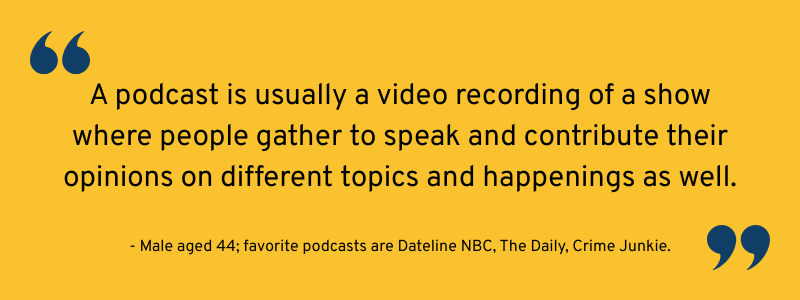
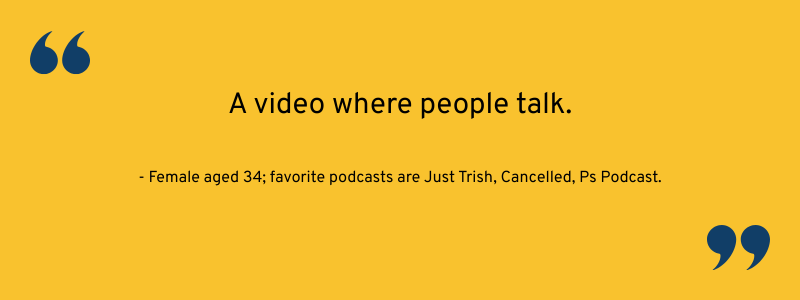
Only 7% of those who’ve ever consumed a podcast said it’s a video program or something that you watch, without any mention of audio or some kind of listening. Here are a couple of examples*:
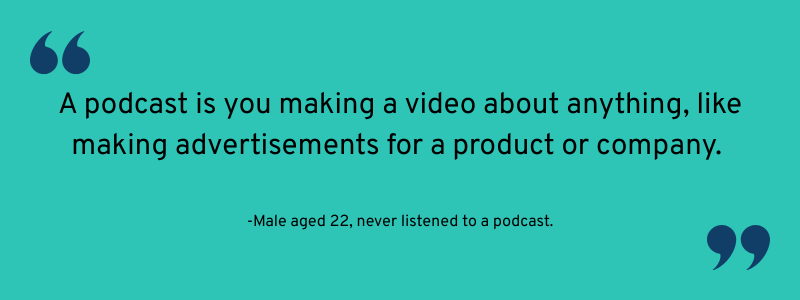
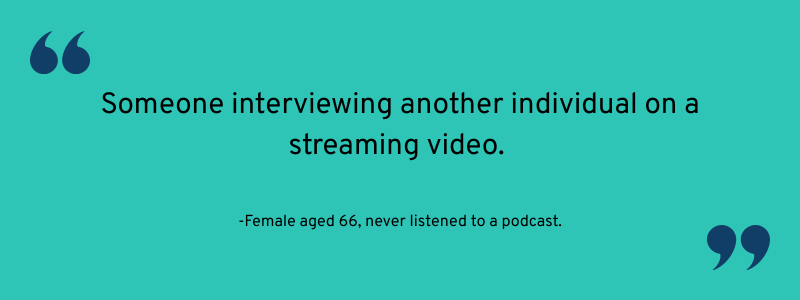
A slightly higher percentage – 8% – of the never-listened group gave a video-only definition, like these:
Flipping the analysis, a larger portion across each group only defines podcasts using language around audio or listening: 33% of the never-listened, and 38% of the ever-listened. They said things like,
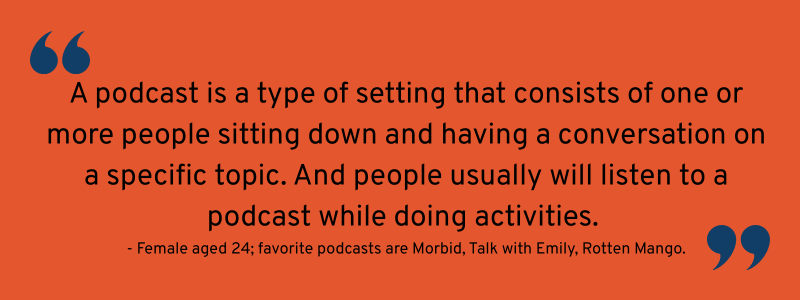
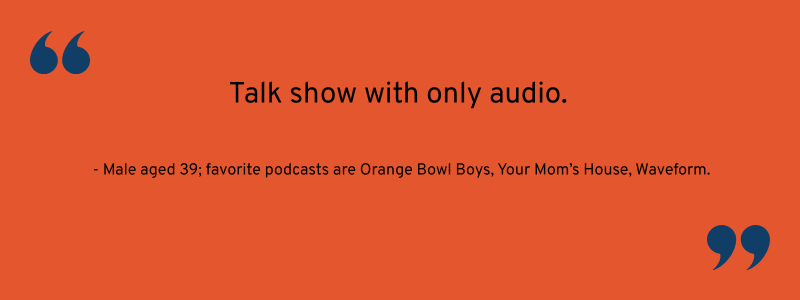
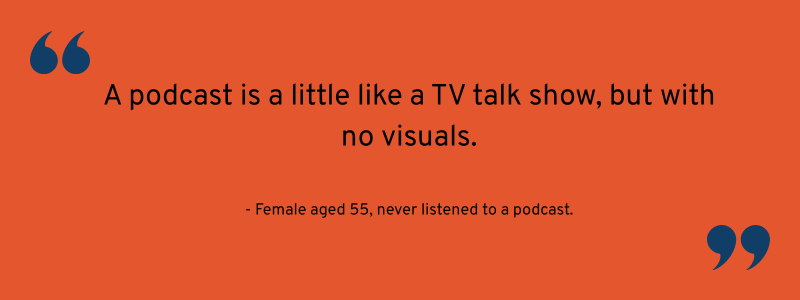
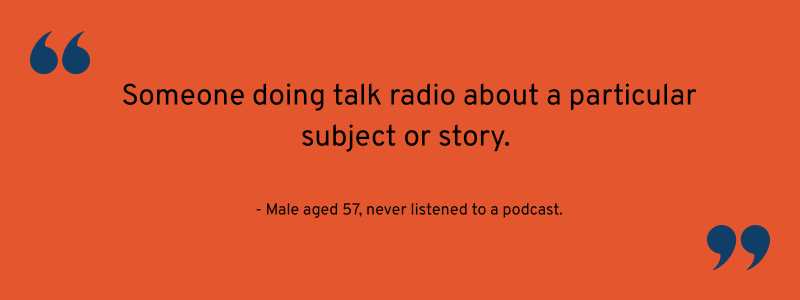
Comparing podcasts to radio, as in this last quote, was not uncommon, with a little under a fifth of listeners – 18% – and non-listeners – 17% – making the analogy.
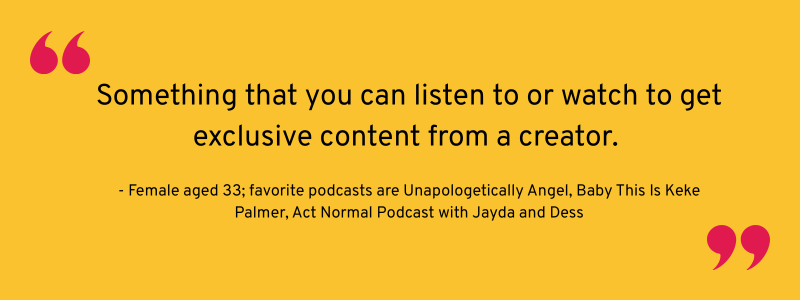
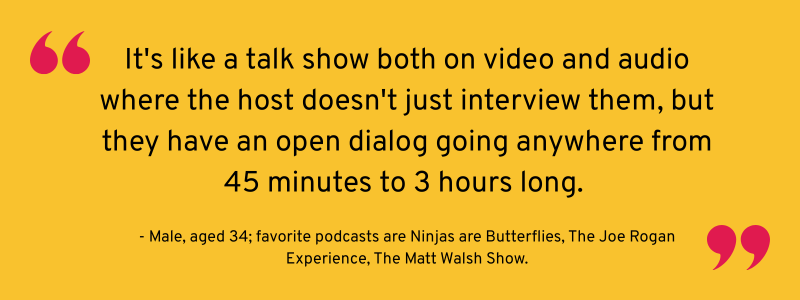
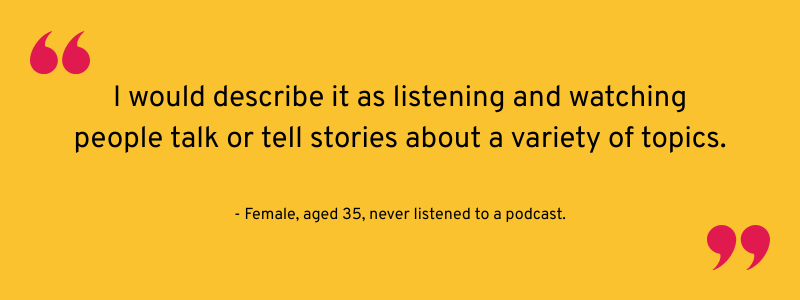
When it comes to the fact that podcasts are now an audio or video medium, very few respondents explicitly mentioned this in their descriptions: 2% of the ever-listened group, and 3% of the never-listened. Here’s how several of these respondents tackled this theme:
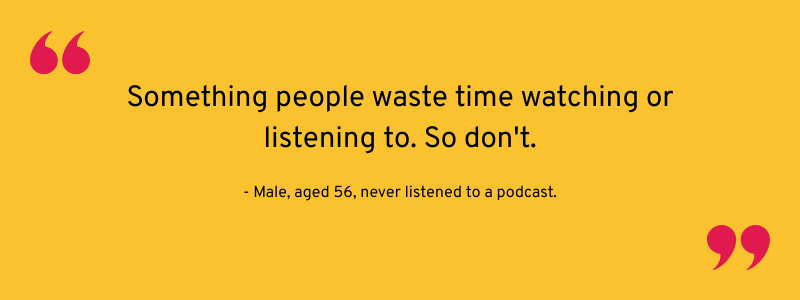
As an aside, negative responses like this last one were actually pretty rare. Perhaps not surprisingly, those who’ve never listened to a podcast were comparatively more likely to express a critical opinion. 2% of the never-listened group cast podcasts in a negative light, while only .3% of the ever-listened group did.
Tallying things up, just about half of all respondents described podcasts using terms directly referring to audio or video, comparing them to radio or TV, or by mentioning how you consume them, through listening or watching. The other half instead tended to focus on format and content.
Defining Podcasts by Content and Format
Broadly speaking, about two-thirds of these respondents – or about a third of all respondents – describe podcasts as being media where people express personal opinions and share stories, with the role of dialogue and discussion being prominent. About the same proportion of the ever-listeneds’ and never-listeneds’ descriptions fit this theme. Some examples:
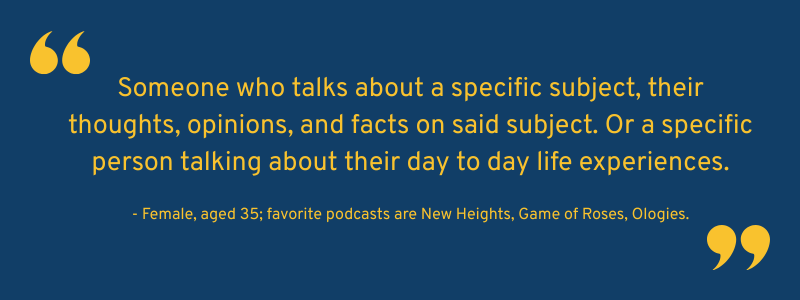
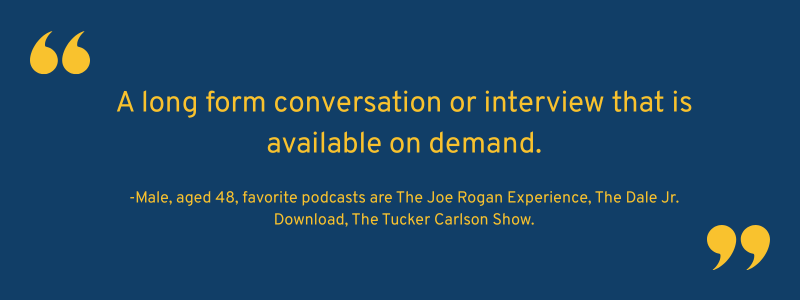
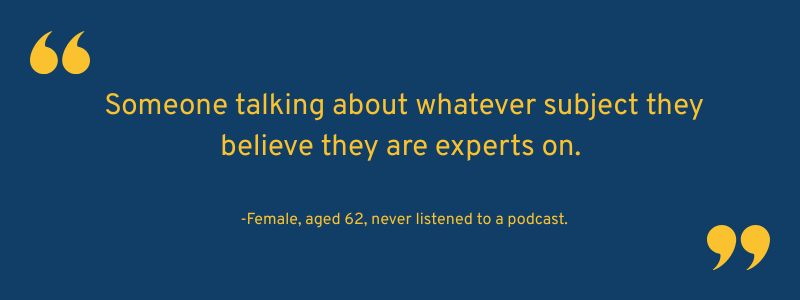
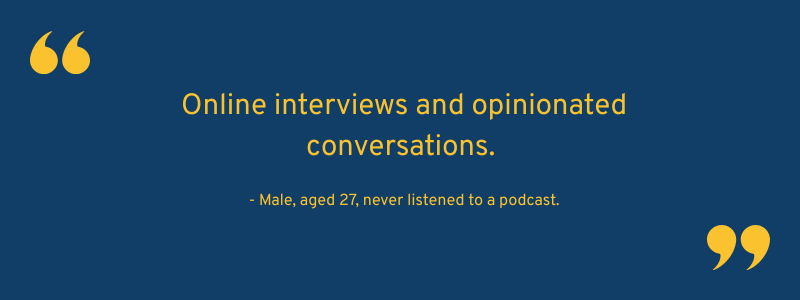
About half of respondents who don’t mention audio / listening or video / watching highlight that podcasts tend to be focused on a specific topic, and often are informative or educational. Some respondents addressed more than one theme, so these sets do overlap.
A slightly larger portion of the ever-listened group (8% more) keyed in on this topical and informational aspect, compared to the never-listened group. Respondents in both groups said things like:
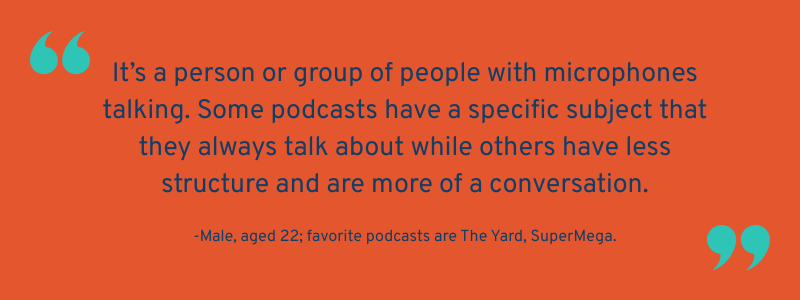
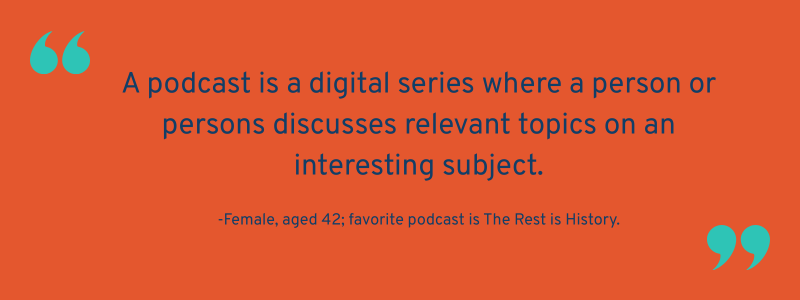
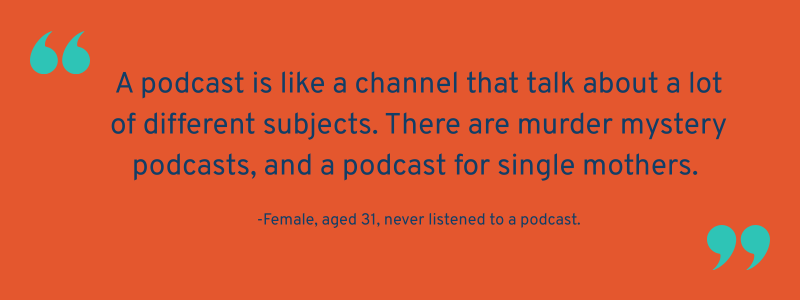
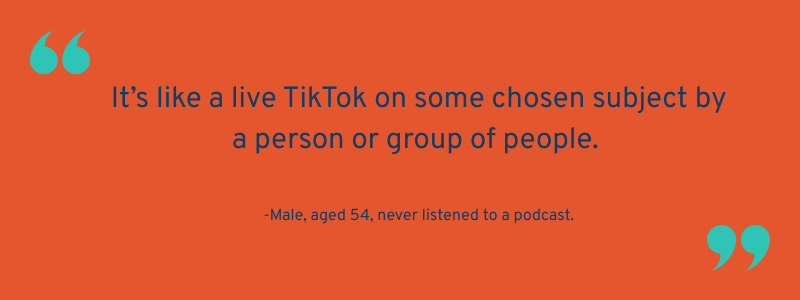
By the way, only a very small number of respondents – a fraction of 1% – compared podcasts to social media, or even said that podcasts were on social media.
People Know What a Podcast Is, Though Audio Isn’t Always Top-of-Mind
My biggest takeaway from this exercise is that when we ask the general public to describe a podcast, nearly everyone today is able to provide a coherent definition that I think most people in the industry would recognize as capturing at least one key aspect. That kind of clear mindshare is a definite success, especially with the never-listened group – they seem to understand generally what a podcast is, even if they haven’t yet checked one out.
At the same time, it’s notable that only about a third of people explicitly said that a podcast is audio, or something that you listen to. Of course, this doesn’t mean that respondents aren’t aware of podcasts’ audio roots. Later in the survey we asked directly, “When you think of a podcast, do you expect it to be audio or video?” 26% said “audio only” and 38% said, “usually audio, may be video” – 64% overall. Only 3% said a podcast is “video-only.”
While most Americans associate audio with podcasts, their verbatim definitions show it’s only top-of-mind for a minority.
As I’m wont to do, I see this as an opportunity for education. As the AMP Accords short definition makes clear, audio is podcasting’s defining feature, and one of its key advantages for the consumer. As Podnews editor James Cridland put it, “Podcasts are something for your ears when the ears are busy.” He even printed the phrase on stickers he hands out at conferences.
It would be sensible for podcasters and hosts to talk up this advantage to their audiences, teach them about the ways podcasts can accompany their daily lives. Though this may seem obvious to those of us who’ve been inhaling podcasts for years (or decades), it may not be so apparent to the person who discovered the form on YouTube or TikTok.
Beyond growing the audience and visibility of podcasting, the rise of video podcasting has also forced this effort to distill the true essence of podcasts, rather than simply assume everyone just gets it. As the industry zeros in on a definition that both sufficiently differentiates and describes a podcast, the next step is to evangelize the good word, so that the benefits of media that’s independent of screens can be widely enjoyed and recognized.
*Quotes from respondents have been lightly edited for spelling and grammar.