
Paul Riismandel
Dear Podcaster, when was the last time you reminded your audience they can listen to just the audio of your show?
For anyone who’s been in podcasting for more than five years this sounds like an absurd question. But it’s not 2020 anymore, and it’s become abundantly clear that consumers no longer think of podcasts strictly as an audio medium. Moreover, that perspective is changing rapidly.
While I believe video has been a net positive for podcasting, helping to grow the audience to reach a broader diversity of consumers, that growth is at risk if podcasters and the industry don’t refresh the advantages of just listening to audio.
The Shifting Landscape from Audio-Only to Audio or Video
In the 2023 edition of The Podcast Landscape – conducted by Sounds Profitable in partnership with Signal Hill Insights – we asked monthly podcast consumers if they expect a podcast to be audio or video. At that time 67% of podcast consumers said that they expect it to be “audio-only” or “usually audio-only.” Following up in 2024, that percentage dropped a bit to 64%. Now, in the most recent 2025 edition, it’s dropped more to 59% who say podcasts are primarily an audio medium. That’s a decrease of eight points in two years.
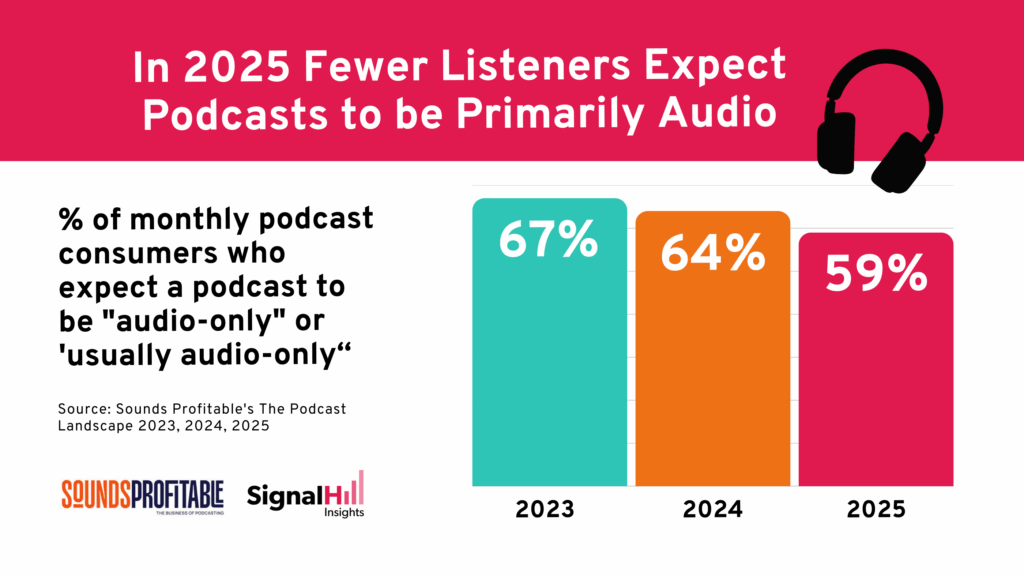
The change is more pronounced among the newest listeners. Looking at those who’ve just started with podcasts in the previous 60 days, in 2025 52% say a podcast is “audio-only” or “usually audio-only” – down eight points from the previous year, and seven points lower than the average for all podcast consumers.
I’m putting a spotlight on these brand-new consumers because their expectations are being set based upon their experience right now, with fewer of the preconceptions held by those who’ve been into podcasts for years and years. Their views serve as an early warning sign of where things are headed.
A Preference for Video Podcasts and Consuming at Home
I see other signs that the benefits of podcasting being audio-centric are at risk of being forgotten.
In the recent Fall 2025 edition of the Download on Podcasts, which Signal Hill conducts in partnership with Cumulus Media, we asked weekly podcast consumers where they consumed their last podcast. Overall 79% said they consumed that podcast at home, while 11% said they consumed it in a private vehicle.
However, those who say that they prefer audio-only podcasts are nearly twice as likely to have consumed that last podcast in a vehicle: 21%. Moreover, a full third of those preferring audio-only said they listened outside the home, whereas only a fifth overall did.
Podcast newcomers – those who started with podcasts less than a year ago – were even less likely to have listened in a car or outside the home. Only 8% and 17% did so, respectively.
The biggest homebodies? They’re the podcast consumers who say they prefer a video podcast “you actively watch.” 88% said they consumed their last podcast at home. The thing is, this group comprises a full half of the weekly podcast audience.
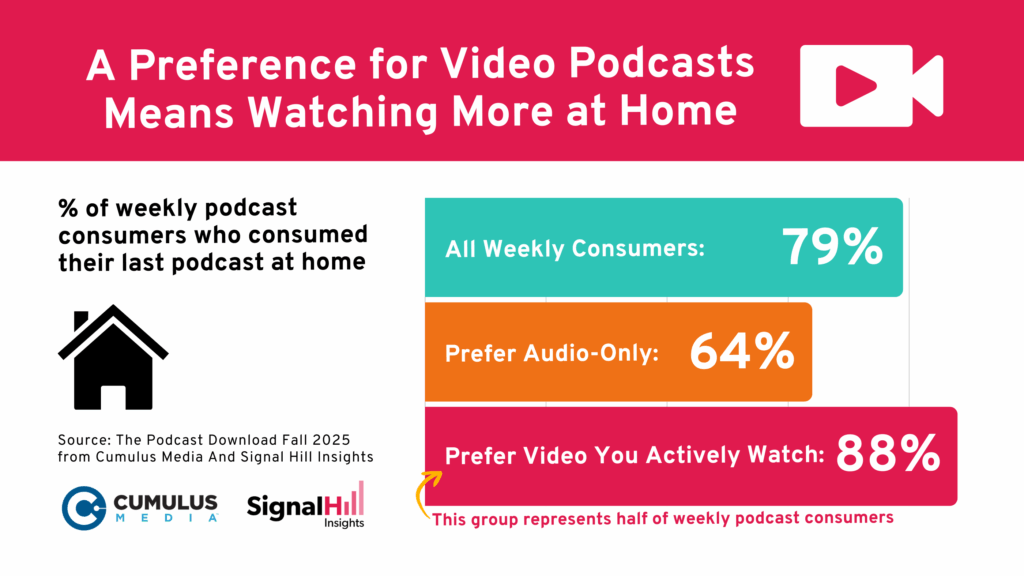
Let that sink in a moment. One outcome of the shift to video appears to be a bias towards consuming podcasts at home, rather than at work or on-the-go.
Why is that?
Video Isn’t Designed for On-the-Go
Let’s think about the fundamental practicality of watching video: you generally want to keep your eyes on the screen some portion of the time. That rules out safely or conveniently watching while you’re doing any number of activities, from walking down the street, driving a vehicle, doing household chores or working at your job.
It requires that you’re mostly sitting or standing in one place, where your eyes aren’t needed for something else. No wonder those who prefer video podcasts are so likely to be watching at home.
And if you want to be moving around while watching a video podcast, home is also the best place to do it. You can place a smartphone, tablet or laptop on a table, and go about your business while glancing back as necessary. Or, you could pull up a podcast on your smart TV while you cook, straighten up, work on a puzzle or engage in pretty much any activity where you’d also want your mind to be occupied with a podcast.
That might be one reason why we’ve seen smart TVs become the second most commonly used device for podcasts among weekly podcast consumers. In this fall’s Download on Podcasts 35% say they use Smart TVs, ranking only behind smartphones. Even 12% say that it was the last device they used to consume a podcast – again second only to smartphones.
Podcasts Were Born On-the-Go
I’m struck by this trend because I remember when podcasting emerged, in the time before internet video was anywhere close to practical or accessible. Podcasting was the first on-demand internet media because audio was easier and far cheaper to transfer over the ‘net. The medium itself was even named after a portable digital audio player, the iPod.
Portability, in fact, was critical. The iPod (or any MP3 player) let you take your spoken audio programs – your podcasts – wherever you wanted to go. While portable audio devices had been common for decades prior, in the days before smartphones and wi-fi this was the first time that you could easily take something downloaded from the internet outside your house, anywhere in the world, rather than being tethered to a computer.
The allure was utterly tied to audio – media you can consume with just your ears, leaving your eyes free to help you navigate city streets, mow the lawn, go jogging, fix your car, or do any one of thousands of other activities.
Keeping Podcasts at Home Stunts the Medium’s Growth
My concern is that this deeply important benefit of podcasting may be getting lost with the growth in video podcast consumption. My concern is not driven by nostalgia or a purist’s viewpoint that podcasts must be audio-only. Instead, I worry that a focus on video obscures audio’s virtues, threatening to limit how much people will use podcasts.
It’s clear that at least some of the podcast audience understands audio’s advantages. Just over half of YouTube podcast consumers (52%) tell us they listen at least some of the same shows on other platforms. When we ask them why, nearly three-quarters (73%) say it’s because they want to access those podcasts in contexts where they’re only able to listen.
At that same time, just under half of YouTube podcast viewers aren’t making that migration off the platform. This means they’re far less likely to take their podcasts on-the-go and ue them to enhance their commutes, housework, exercise or other activities.
This is a lost opportunity for every podcast on YouTube.
Promote the Advantages of Podcast Audio to Encourage More Listening
Even if your podcast has invested heavily in their video production, why not encourage your audience to find your show on Spotify, Apple Podcasts, Pocket Casts, or even YouTube’s audio-first little brother, YouTube Music?
I get it, we’re used to taking audio for granted. Born out of audio, we’ve long assumed that audiences fundamentally understand that podcasts are pretty much always available in an audio-only version. But as I’ve shown, we can’t continue to make this assumption. Every day new podcast consumers are coming into a medium that is less and less defined by audio-only.
If a viewer new to podcasts finds their first show on YouTube (the most likely place they’d find it), why do we expect they’d know it’s available anywhere else. And why would they even want that?
The answer is: we can’t expect that, and they don’t know. Podcasters need to tell them.
It’s not about saying audio is superior to video. Rather, it’s about promoting the freedom of choice, that a podcast fan doesn’t need to be tied to any one platform to get their show. They can watch at home from their couch, or listen to the same show while walking the dog.
So, Dear Podcaster, you can do your part by not only telling your audience they can find your show “wherever your get your podcasts,” but also saying this explicitly includes audio-focused platforms that let them take it on the go. Tell them in the clearest terms why it’s a great thing.
In essence, you’re encouraging them to consume more of your podcast, more often. Why wouldn’t you want that?