Matt Hird
After a brief period in which “video podcasts versus audio podcasts” was not the main news story in the podcast industry space, Apple has reinvigorated the discussion by introducing a new method for viewing video podcasts. The HTTP Live Streaming (HLS) method certainly sounds like an improvement over previous methods of watching video in Apple Podcasts, and I have no doubt that anyone using Apple podcasts for their video consumption will welcome this change, but I’m more interested in looking at what, if any, impact this will have on podcasting in general.
Time Spent with Video Podcasts in North America
First, let’s take a look at where video consumption of podcasts currently sits in North America, based on the Triton Digital / Signal Hill Insights Demos+ survey for the US, and the Canadian Podcast Listener 2025.
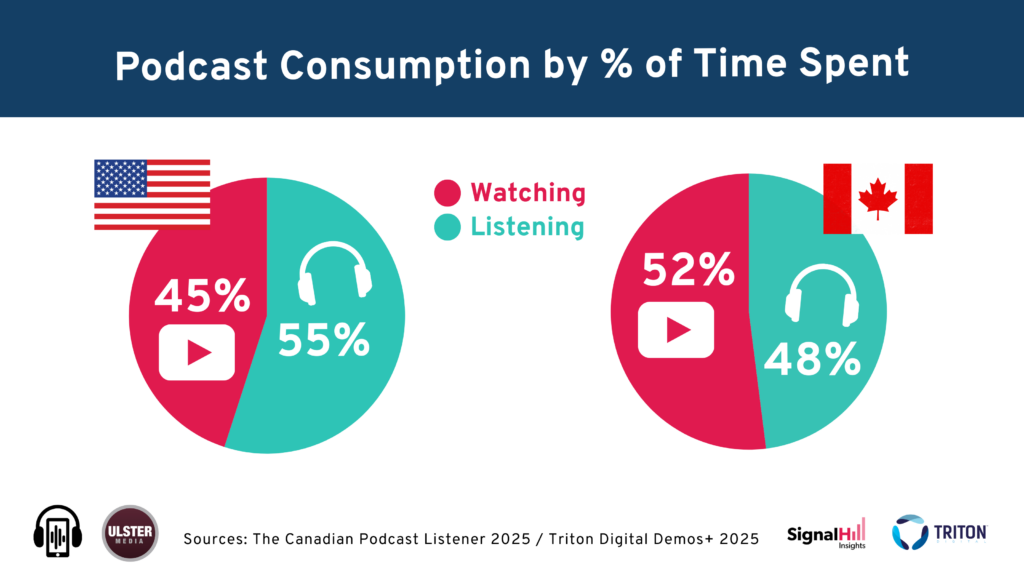
In Canada and the United States, on average, video consumption of podcasts represents 45% of time spent with podcasts on the low end in the U.S., and 52% on the high end, north of the border.
Like any average though, this doesn’t tell the full story. For one, primary language spoken has an impact on this behavior, with time spent watching being higher among those whose primary language is not English. 59.4% of time spent with podcasts among French Canadians is watching, and 49.9% of time spent among Spanish-speaking Americans is watching – considerably higher than the national averages in both countries.
Second, these averages represent time spent, not the proportion of people. It’s easy to look at the chart above and think “okay, half of podcast consumers are watchers and half are listeners,” but just like in politics where the extremes of both sides get the most attention, there’s a sizeable middle ground that’s tough to easily put a label on.
Video Podcast Reach Is Variable by Show
The number of podcast consumers exclusively watching or exclusively listening is actually very small compared to the number that are doing both. And even those doing both aren’t necessarily doing them both consistently. You may watch all your celebrity interview podcasts, but listen to all your news podcasts. Or watch certain news podcasts and listen to others depending on the time of day they’re released and what you’re normally doing at that time. (At your desk vs. in your car?)

Even among the top podcasts the proportion of each one’s reach that comes from audio or video consumption varies widely, as shown in the chart above (names redacted). Just compare the #1 and #10 shows. At the top, a third of the audience only watches, and a bit more than a quarter only listen; the rest listen and watch. But for #10, a clear majority of 59% only listens, while only a smaller proportion just watch (28%) compared to #1.
Apple’s Video Podcast Challenge
While there are good reasons for the excitement around Apple’s new video podcast features, it’s worth asking who they’re going to impact.
As of 2025 just over 1-in-10 monthly podcast consumers in Canada and the United States say that Apple Podcasts is their primary app. In Canada fewer than 1-in-5 used it at any point in the past year, despite 50% of Canadian podcast consumers owning an iPhone as their primary device.

So, at least initially, only a relatively small minority of podcast consumers will be taking advantage. It’s conceivable that this update brings new users to the platform, but Apple has a lot of lost ground to regain. Its share of podcast app usage simply isn’t what it was a few years ago. In 2021, Apple Podcasts was the platform used most often by 18% of Monthly Podcast listeners in both the U.S. and Canada.
Not to diminish the import of these changes, but they’ll likely have much more impact on those who’ve been consuming podcasts for five years or more, a group that I suspect represents a lot of us in the podcast industry itself. That group is simply more likely to use Apple Podcasts most often today.

On the other hand, new listeners are considerably less likely to be using Apple Podcasts as their primary platform than those who started consuming podcasts in the far away past of 2021 or earlier. Apple simply isn’t the springboard to podcast consumption that it once was, and one of the reasons appears to be that multi-content apps, like Spotify and YouTube, are better at bringing in new consumers than single-content ones.
Three Critical Steps for Apple’s Video Podcast Success
With its new video features, Apple needs to take three critical steps in order for its new video features to drive major impact in the video podcast marketplace.
- Convince their current, mostly-audio users to change how they use Apple Podcasts – as an audio platform to a video one. To underline this challenge, in Canada, Apple Podcasts Primaries spend only 28% of their time watching podcasts, as compared to 52% across all podcast consumers.
- Reverse Apple Podcasts’ declining share of platform. Success with shifting its users to video alone will only meaningfully impact just over 10% of podcast consumers in North America
- Retain Apple Podcasts video viewers on platform, instead of losing them to YouTube and Spotify. 85% of Apple Podcasts primaries in Canada use YouTube at least once a week, and 53% use it daily. There’s a risk for Apple in converting audio consumers to video consumers that those new converts will decide to do all their video consumption in the place they’re doing most of it already, rather than in two separate apps.
This is all possible, but not without effort, investment, and marketing. In particular, consumers must know there is desirable video podcast content on Apple Podcasts, and understand the benefits of watching it there.
All the same, podcasting continues to have one of the most diverse ecosystems of consumption platforms, and Apple’s new video features represent a step towards supporting that diversity, rather than consolidation.