For the first time, Podcast Movement Evolutions landed alongside SXSW in Austin—an alignment that felt less like a scheduling coincidence and more like a signal (pun intended) of where the industry is headed.
Our CEO, Paul Riismandel, and VP of Research, Matt Hird, were on the ground across all three days, tracking the conversations that matter most to advertisers, publishers, and creators alike. What emerged wasn’t a single trend—it was a picture of a medium hitting a new phase of maturity.
Here are the themes that stood out.
1. Authenticity Isn’t a “Nice to Have.” It’s a Performance Lever.
If there was one idea that kept surfacing, from indie creators to agency leaders, it was this: authenticity drives results. Even if that means a genuine rebuff.
On a panel with ADOPTER Media, The Paragon Collective, and Podscribe, the idea of saying “no” came up again and again. Not as resistance, but as a strategic choice. When creators walk away from partnerships that don’t match their voice or values, they aren’t giving up revenue. They’re protecting the trust they’ve built with their audience. And that trust is what makes campaigns work.
This isn’t just a feel-good concept. It’s measurable. Data shared by Podscribe backed up what Signal Hill’s brand lift studies have shown for years. When host endorsements feel sincere, performance improves across the board, from brand recall to visitation to purchase intent.
Or, put simply: people know when it’s real. And they act on it.
2. Measurement Is Expanding—But Alignment Still Needs Work
If authenticity is the fuel, measurement is the dashboard…and it’s getting more sophisticated, quickly. Across multiple sessions, the industry’s reliance on downloads as a primary KPI continued to erode. In its place: a broader mix of signals, including real listens, playback behavior, and time spent.
That shift reflects a deeper understanding of what makes podcasting work. It’s not just about reach—it’s about attention and engagement.
At the same time, marketers are under pressure to connect podcast performance to broader business outcomes. As Whole Foods’ Paid Media Lead, Gladwell Mwangi, put it, brands increasingly need to tie impressions to lift. It’s a challenge that the Signal Hill Insights team has addressed directly—and one that brand lift measurement is specifically built to address.
But that’s where things get complicated.
Different players—buyers, publishers, platforms—are still working from different datasets and definitions. Add in new formats like video, and the gaps can widen quickly. The opportunity ahead isn’t just better measurement tools. It’s better alignment on what success looks like—and how to prove it across channels.
3. The Growth Loop Is Real—But It Starts Smaller Than You Think
Another clear takeaway: brands don’t need massive budgets to get started in podcasting.
In fact, several speakers emphasized the opposite. Successful campaigns often begin with focused test-and-learn strategies—identifying the right shows, defining clear objectives, and building from there. As Horizon Media SVP Maria Tullin noted, planning has evolved from “try a few shows” to structured experimentation across creators, platforms, and formats.
That approach mirrors what Signal Hill sees in effective campaigns: start with intentionality, measure what matters, and scale what works.
Importantly, not every campaign is built for immediate conversion. Some are about shifting perception, reaching niche professional audiences, or supporting broader brand narratives. Which means measurement, and expectations, have to flex accordingly.
4. Monetization Is Diversifying—Fast
The days of podcast monetization being synonymous with host-read ads are long gone.
Today’s ecosystem includes programmatic buying, dynamic ad insertion, video extensions, social amplification, live events, and even product launches tied to creator brands. Platforms like ART19 highlighted the scale now possible through programmatic marketplaces—enabling advertisers to reach thousands of shows via audience targeting. Of course, those host reads still tend to outperform producer reads on some measures, but as their Head of Revenue Billy Hartman hopes, programmatic may find ways to up its creative offerings.
At the same time, creators and networks are expanding how and where their audiences engage, often building multi-platform relationships that extend far beyond the podcast feed. But even as formats evolve, the core value proposition remains consistent: the depth of connection between host and listener.
That intimacy is what makes podcasting work—and it’s what new monetization models need to preserve.
5. Video Is Coming Into Focus—Without Replacing Audio
No topic generated more buzz than video, and some of the biggest buzz was tied to Apple’s keynote on its new HLS (HTTP Live Streaming) offering. They made one thing clear: the future isn’t audio vs. video. It’s both.
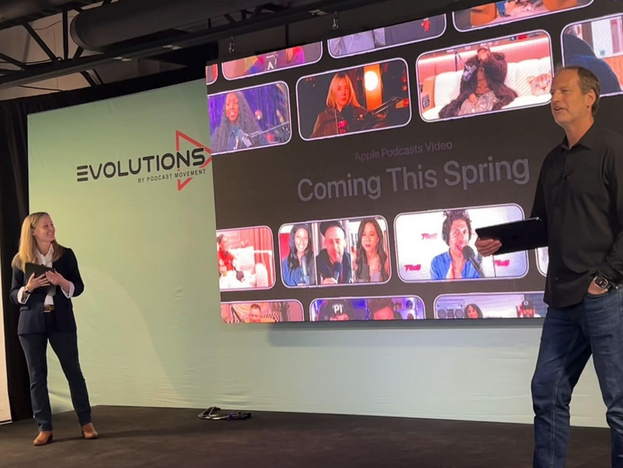
That belief is shaping how they’re building. From seamless switching between formats to dynamic ad insertion in video, Apple is investing in infrastructure designed for hybrid consumption. The goal is a more flexible experience that meets audiences whether they want to listen, watch, or move easily between the two.
But the conversations on the ground suggested a more nuanced reality—one that our own audience data helps illuminate. As Matt explored in his recent post, “Apple’s Video Podcast Impact: What the Audience Data Says”, audiences already move fluidly between audio and video depending on context; watching when they can, listening when they can’t. That data also shows that the proportion of audio vs. video consumption varies significantly by show, by genre, and even by the listener’s primary language. There’s no single “video podcast audience”—there are many.
As Acast’s Greg Glenday put it on his panel in Austin, podcasts are a choice driven medium – “sought, not served.” He promises new tech to help ensure brands aren’t paying for a video ad when a phone is in someone’s pocket. And as Hetal Patel of iHeartMedia emphasized, the bigger opportunity is aligning format with behavior in the first place.
6. Independent Creators Are Redefining the Playbook
Finally, the rise of independent creators continues to reshape the industry.
Voices like Hala Taha of Young & Profiting and the MeidasTouch network brothers highlighted both the challenges and advantages of building outside traditional structures. Independence comes with a steep learning curve, like understanding monetization, partnerships, and audience development from the ground up. But it also unlocks something powerful: direct relationships with both listeners and advertisers.
The Bottom Line
For the all the changes and evolutions in podcasting, one fact remains unchanged: it’s still built on trust. Trust between podcaster, audience and advertiser.
For advertisers, the implication is clear: success in podcasting doesn’t come from forcing it to behave like other channels. It comes from understanding what makes it different—and building strategies that respect that difference. Measurement executed with focus and intentionality strengthens that trust.