Matt Hird
Happy New Year! As we closed out 2025, Jeff Ulster of Ulster Media and I started making the rounds presenting the results of The Canadian Podcast Listener 2025 to our sponsors and subscribers. It’s always encouraging to see how eagerly this report is anticipated each year, and the variety of questions we get during the presentations are a testament to how diverse the needs of the Canadian podcast industry is.
While the full report and data tables are only available to the subscribers who make this immense undertaking possible, one of the goals of The Canadian Podcast Listener is, and always has been, to provide a baseline understanding of the trends in the podcast industry to everyone. Podcasting is a long-tail medium, and there are thousands of independent podcasters, sound designers, marketers and advertisers who are not yet CPL subscribers, and may not have the resources to commission their own research, but for whom a little information could set them up for future success.
Beyond the exceptional year-over-year growth we saw in podcast consumption in 2025, here are a few of the big takeaways we’re happy to share from the public summary report of the study.
#1 – In Canada podcasts are consumed increasingly – but not exclusively – as videos
Much has been said about YouTube’s growth as the platform of choice for podcast consumption, and this trend certainly holds true in Canada; YouTube is now the platform used most often by 40% of monthly podcast users in the country.
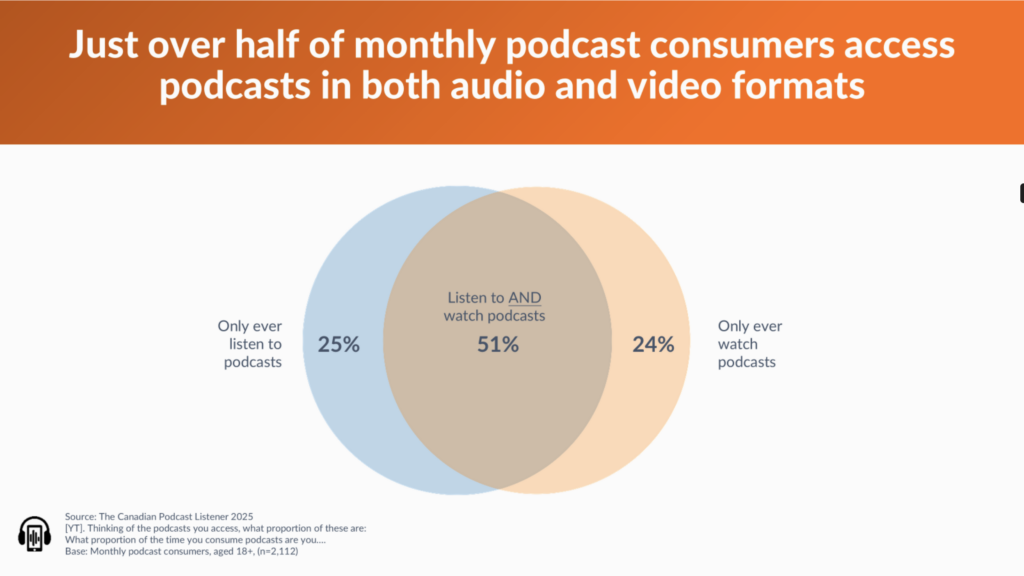
What gets less attention is that “most often” doesn’t mean “exclusively,” and those consuming video podcasts are listening to those shows on other platforms as well. Only 24% of monthly users in Canada say they only consume their podcasts in video form, with the remaining 76% spending at least some of their time with podcasts in an audio-only environment.
Aggregating the behaviour of all podcast users only tells part of the story. 2025 is the first year that our full study covers listening versus watching by individual podcast. Half of the Top 10 podcasts on CPL’s whole-market Canadian Podcast Chart are having no problem maintaining their positions even though the majority of their audiences say they “listen only.” Stay tuned for more details on this.
#2 – Discovery is shifting away from podcast-to-podcast cross-promotion
As recently as 2020, more than 1-in-5 (22%) Canadian podcast consumers said they discovered their most recent new show on another podcast. This was higher still among power users –those consuming 5 or more hours of podcasts a week –where a third found their most recent show on another podcast. When trying to reach those already in the podcasting tent, a publisher could do a lot worse than promoting their podcast on other shows.
In 2025, podcast-to-podcast discovery has since dropped to 13% overall and 16% among power users. What’s replacing it is an increase in in-app discovery. This can be a combination of algorithmic recommendations and paid promotion, but it speaks to the impact that platform shifts over the past five years –towards YouTube and Spotify –have had on discovery.

#3 – Podcasts are resistant to ad avoidance
One of my favorite quotes about advertising comes from Dr. Samuel Johnson in 1759:
“Advertisements are now so numerous that they are very negligently perused.”
While he was referring specifically to personal classified ads in print media, the idea that we had hit the point of diminishing returns on advertising 250 years ago feels quaint in the context of our advertising exposure in the age of digital media. Contrary to Dr. Johnson’s inference, advertising remains effective, but some media are more “negligently perused” than others.
Among monthly podcast listeners, podcast ads are the least likely to be consistently avoided. While there is a perception that ad loads on podcasts have gradually increased, skipping behaviour has remained low on podcasts due to qualities inherent to the media as well as the creatives themselves. Podcast consumers understand the connection between the advertising and the continued existence of the content, and ads tailored for in-ear consumption and often read by the host tend to minimize disruption with the content..

We hope you’ll check out the summary report of 2025’s Canadian Podcast Listener study here, and that 2026 marks another successful year for you and the rest of the podcast industry – in Canada and elsewhere.